Printing and paper
- A stable 45-65 % RH prevents sheet curling and waving
- Better colour registration, fewer press stoppages
- Static elimination on high-speed lines

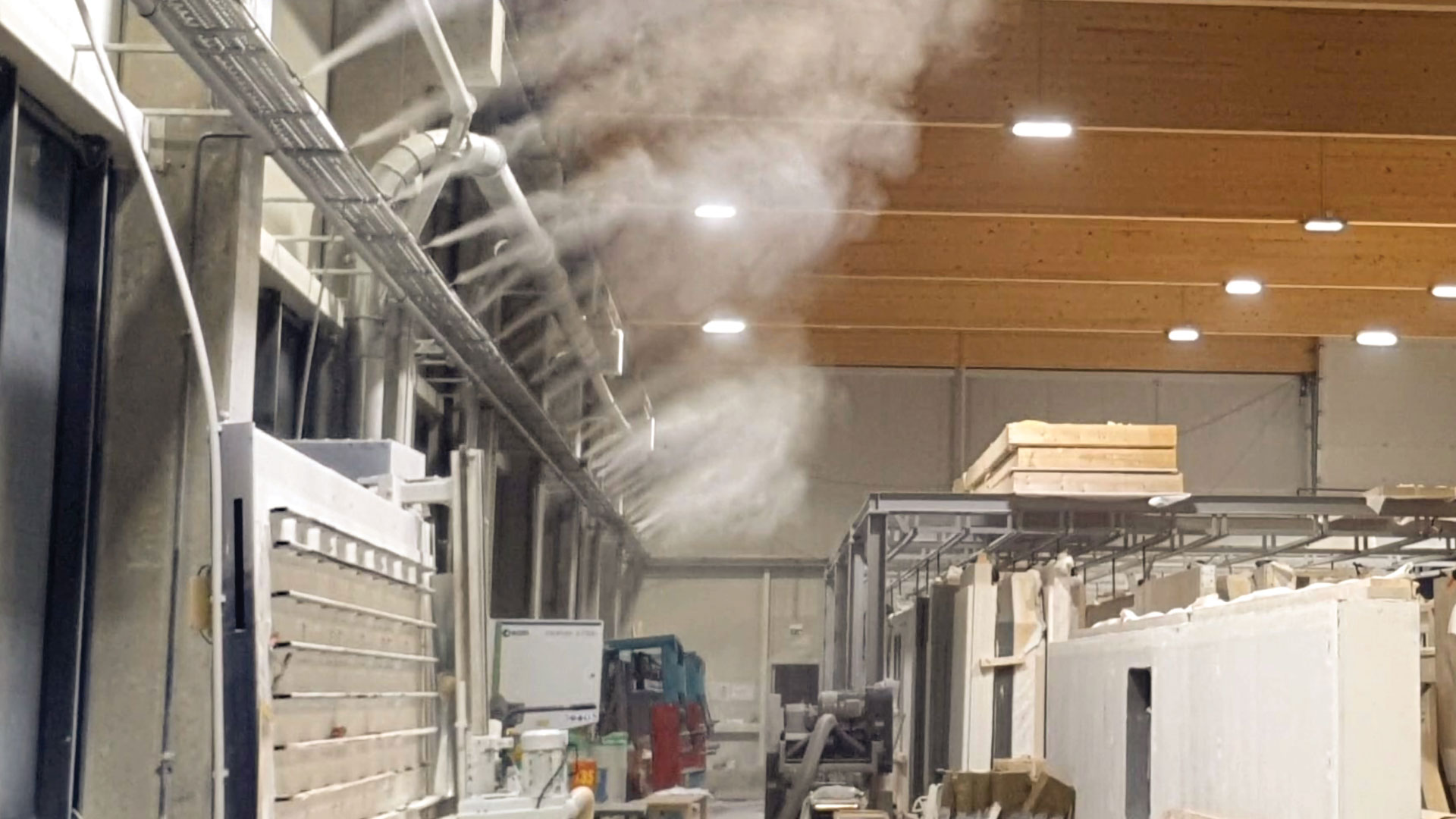
High-pressure dry fog for production halls - stable relative humidity, hall cooling, dust suppression, elimination of static and odours. No wet surfaces, a tenth of the energy of steam systems. One system: humidity, cooling, dust, odours.
No competing solution on the market covers everything at once: steam only humidifies and heats the hall, air-conditioning only cools, extraction only captures dust. sTorks combines all functions in one installation.
A relative-humidity and temperature sensor automatically maintains the target humidity in production (e.g. 45-65 % for printing, 65-85 % for textiles) regardless of season and heating. The system switches on only when humidity falls below the set limit and stops at the target value, so humidity does not fluctuate - hygroscopic materials keep their weight, shape and strength, and rejects from warping, shrinking and cracking fall.
Evaporation of water removes heat from the air and cools the hall by −4 to −16 °C, depending on inlet temperature and humidity. Each 15 µm nozzle removes about 2 kW of heat from the air as it evaporates - cooling is a by-product of humidification, so it adds no heat to the hall like steam systems and improves summer working conditions without high air-conditioning costs.
The fog pre-cools the intake air of condensers, chillers and fresh-air intake systems. A lower intake-air temperature raises the efficiency and cooling capacity of the equipment and lowers its energy consumption - especially on hot summer days, when chillers are most loaded and least efficient.
Fine fog binds airborne dust: the droplets increase particle mass so particles settle faster. This lowers dust concentration across the whole hall, improves air quality and visibility, and reduces dust-explosion risk where relevant. It complements local extraction at the source - it does not replace it.
Dry air is an insulator, so static electricity builds up, stops machines, damages electronics and attracts dust. Stable relative humidity above ~45 % naturally drains the charge from surfaces and materials - fewer stoppages on fast lines, fewer faults when assembling sensitive components and lower spark risk.
The fog binds and neutralises odours in production halls, at municipal and recycling stations and on transfer lines. The droplets capture volatile particles in the air and settle them, with neutralising additives where needed - reducing unpleasant smells in the building and its surroundings without aggressive ventilation.
When heating and ventilation dry the air below 30 % relative humidity in winter, it shows in the material and the reject rate. Humidity control in production is not a comfort - it is a quality parameter that most plants do not measure until it becomes a cost.
Paper curls, waves and cracks, colour registration in print drifts; wood shrinks and splits; yarn breaks and dust rises. Hygroscopic materials follow the relative humidity of the air - at too-low humidity they lose weight, shape and strength. Print shops typically require 55-65 % RH, textiles 65-85 % RH.
Dry air is an insulator: static electricity stops machines, damages electronics, attracts dust and is a spark risk. Airborne dust degrades air and product quality. Stable relative humidity above ~45 % drains the charge naturally and binds dust so it settles.
A curled print sheet, a cracked piece of wood, a torn thread, a dried-out food product with lower weight - each is a silent cost. Controlled humidity reduces rejects, machine stoppages and complaints, while adiabatically cooling the hall and improving working conditions.
Adiabatic cooling provides more pleasant working conditions with controlled air humidity, lower temperature and reduced dusting. Such an environment improves employee comfort and can contribute to lower absence and higher efficiency.
Target relative humidities and effects are indicative - final values are set after measurements and a site visit.
High pressure (90-100 bar) atomises water into 3-20 µm droplets - a dry fog that evaporates in milliseconds. As it evaporates, every litre of water removes heat from the air, so humidity rises and temperature falls while surfaces stay dry. Humidity and temperature sensors keep the microclimate in the optimum window for each industry.
| Working pressure | 90-100 bar |
|---|---|
| Droplet size | 3-20 µm (standard 15 µm) |
| Nozzle flow | 0.05 L/min |
| Temperature drop | −4 to −16 °C (adiabatic) |
| Pump | 0.75-2.5 kW, high-pressure |
| Filtration | 50 µm + 1 µm + UV sterilisation |
| Noise | <25 dB at nozzles · <65 dB at pump |
| Control | Automatic, T + RH sensors |
| Line system | 11 mm multilayer black tube or 8 mm stainless tube |
| Standards | CE · MD · RoHS · EN ISO 22000 |
Hygiene in humidification is not an adjective, it is a specification. We prove it with measurable parameters: multi-stage filtration, UV sterilisation and anti-drip nozzles with no dripping at switchovers - suitable for food plants and HACCP environments in line with EN ISO 22000.
The market is dominated by agents of German and Swiss brands (steam and two-fluid systems). sTorks designs and hand-builds its systems in Kranj - with direct engineering contact, and service and spare parts from Slovenia within days.
We design, build and install the systems ourselves. Direct contact with the engineer who knows your project - no middlemen.
Components and nozzles of proven quality, compliant with CE · MD · RoHS · EN ISO 22000.
2-year warranty, 10+ years of service, spare parts from stock. Project delivery with commissioning within days of confirmation.
"One system: humidity, cooling, dust, static, odours. We solve all four at once."
sTorks · Kranj · manufacturer since 2005No, if the system is correctly sized. At 90-100 bar a dry fog forms with 3-20 µm droplets (standard 15 µm) that evaporates in milliseconds before it reaches the floor or equipment. Anti-drip nozzles prevent dripping on start and stop. A relative-humidity sensor keeps humidity within the target window, so surfaces, products and electronics stay dry. The elimination of static electricity enabled by stable humidity additionally protects electronics.
Adiabatic cooling lowers the air temperature by −4 to −16 °C, depending on the inlet temperature and relative humidity - the effect is greatest in hot, dry air and smaller in already humid air. Each 15 µm nozzle removes about 2 kW of heat from the air as it evaporates. Cooling is a by-product of evaporation, so it adds no heat to the hall like steam systems do.
A nozzle uses about 0.05 L/min of water. Electricity is used only by the 0.75-2.5 kW high-pressure pump, depending on system size. For comparison: for 50 kg of moisture per hour a steam system uses about 37 kW of electric or gas energy, a high-pressure adiabatic system 1.5-2.5 kW (pump only). Multiply the difference by your electricity price to get the annual saving.
It does not replace local extraction at the source - it complements it. Fine fog binds airborne dust - the droplets increase particle mass so particles settle faster. This lowers dust concentration across the whole hall, improves air quality and reduces dust-explosion risk in industries where that is relevant. Machine-side extraction and in-room dust suppression work best combined.
Yes. Water passes through 50 µm + 1 µm filtration and UV sterilisation, and anti-drip nozzles prevent dripping during interval operation (e.g. 10 s on / 10 s off). The system is designed in line with EN ISO 22000 and suitable for HACCP environments. Stainless components and hygienic design allow use in food processing and storage, where humidity control is key to product weight, appearance and shelf life.
Humidification is needed precisely in winter, when heating dries the air and relative humidity falls below 30 %. The system runs year-round; for winter operation we use heated and drainable line sections and frost protection for the pump station. Control via temperature and humidity sensors automatically maintains the target relative humidity regardless of season.
Two-fluid systems (compressed air + water) were once the standard. Today they are the most expensive way to humidify: compressed air is the most expensive energy in a plant, and two-fluid nozzles consume it whenever the system runs, with constant nozzle clogging. High-pressure water-only humidification achieves the same effect with a fraction of the energy and no nozzle clogging.
The existing line system can often be kept or replaced in phases so production keeps running. The pump station goes into a technical room, nozzle lines above the zones where humidity is needed.
Send us data on your existing system and compressed-air consumption. We measure actual usage, calculate energy savings and payback, and prepare a replacement proposal.
Steam humidification boils water - it uses about 750 W of electric or gas energy per kg/h of moisture and heats the hall in the process. Adiabatic humidification evaporates water at about a tenth of that electrical input and cools the hall as it does so. The comparison of adiabatic and steam humidification is therefore first of all about energy.
| SteamElectric / gas | Compressed airTwo-fluid | High-pressure adiabaticsTorks | |
|---|---|---|---|
| Energy use | ~750 W per kg/h of moisture - water must be boiled | High - a running compressor for compressed air | Low - only a 0.75-2.5 kW pump (~1/10 of steam) |
| Side effect | Heats the hall (adds heat) | Noise and condensate | Cools the hall (−4 to −16 °C) |
| Maintenance | Boiler, water conductivity, limescale | Compressor, oil, two media | Filters + UV, one medium (water) |
| Where it makes sense | Sterile environments (pharma) | Existing, outdated | Production halls, print, wood, textiles, food, logistics |
At 50 kg of moisture per hour a steam system uses about 37 kW, a high-pressure adiabatic one 1.5-2.5 kW (pump only). Multiply the difference by your electricity price and operating hours - that is the annual saving. Steam remains sensible in sterile environments; in production halls adiabatic humidification wins.
Tell us what kind of hall it is, what you produce and which system you have now.